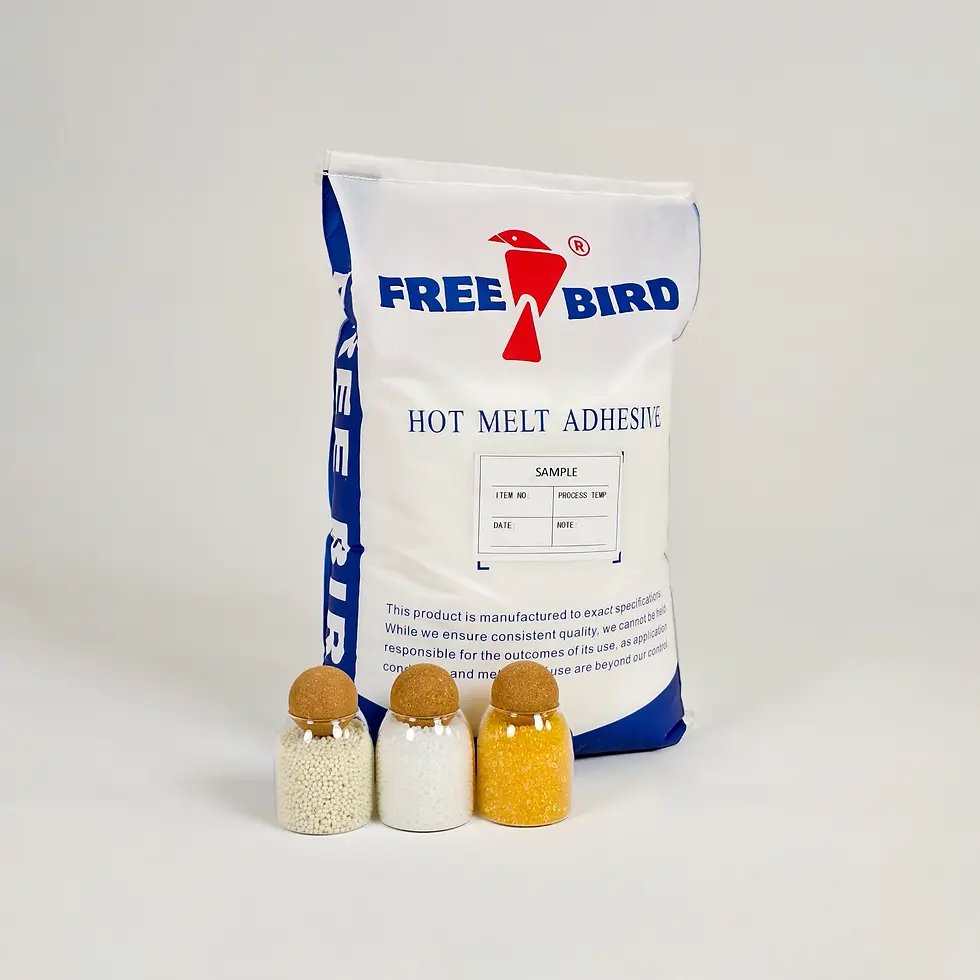
Comparing EVA, PO and PUR Hot Melt Adhesives for Various Applications

Updated: Sep 7
Hot melt adhesives are widely used in furniture manufacturing, bookbinding, packaging, and many other industrial applications due to their fast bonding, solvent-free processing, and high production efficiency.
Among the different hot melt adhesive technologies, EVA (Ethylene Vinyl Acetate), PO (Polyolefin), and PUR (Polyurethane) are the three most widely used. Although they all provide reliable bonding, they differ significantly in performance, processing, and application. Understanding these differences helps manufacturers select the most suitable adhesive for their production needs.
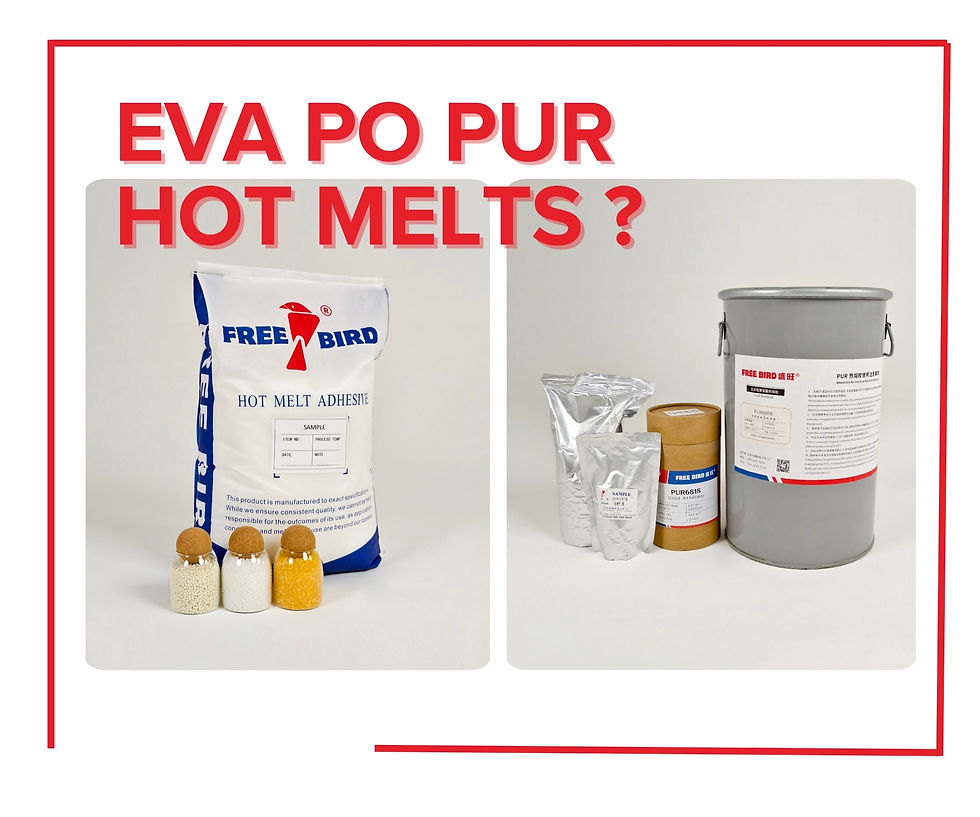
EVA Hot Melt Adhesives (Ethylene Vinyl Acetate)
EVA hot melt adhesive is the most common and cost-effective solution for general-purpose industrial bonding. It offers excellent processing stability, fast setting speed, and reliable adhesion, making it the preferred choice for high-volume production.
Best Applications
Why Choose EVA?
Cost-effective
EVA provides an excellent balance between bonding performance and material cost, making it ideal for large-scale production.
Easy Processing
EVA adhesives work with most standard hot melt equipment and offer fast melting, stable application, and high production efficiency.
Excellent Adhesion to Porous Materials
They bond well to wood, paper, cardboard, MDF, particleboard, and non-woven materials, making them suitable for furniture, books, and paper packaging.
Limitations
As a thermoplastic adhesive, EVA softens at elevated temperatures and offers moderate moisture resistance. It is also less suitable for bonding difficult, non-polar materials such as PP and PE.
PO Hot Melt Adhesives (Polyolefin)
PO hot melt adhesives are high-performance thermoplastic adhesives designed for applications requiring better heat resistance, moisture resistance, and compatibility with challenging substrates. Compared with EVA, PO adhesives deliver improved durability while maintaining the high production efficiency of conventional hot melt adhesives.
Best Applications
Carton sealing
Plastic film and coated paper bonding
Packaging requiring heat or moisture resistance
Why Choose PO?
Better Heat Resistance
PO adhesives offer superior temperature resistance, maintaining reliable bonding performance in both high-temperature and low-temperature environments.
Excellent Moisture Resistance
Their low water absorption makes them suitable for humid environments and cold-chain packaging applications.
Better Compatibility with Difficult Materials
PO adhesives bond more effectively to non-polar materials such as PP, PE, coated paper, and plastic films than EVA adhesives.
Cleaner Bond Lines
Lower viscosity and improved flow characteristics often result in cleaner glue lines and reduced adhesive consumption, helping improve production efficiency.
Limitations
PO adhesives generally cost more than EVA and require optimized processing parameters to achieve the best bonding performance.
PUR Hot Melt Adhesives (Polyurethane)
PUR hot melt adhesives combine the fast setting of hot melt technology with the long-term durability of moisture curing. After application, the adhesive reacts with moisture in the air or substrate to form a permanent cross-linked bond. This unique curing mechanism gives PUR outstanding strength and environmental resistance, making it the preferred solution for premium furniture manufacturing.
Best Applications
Flat lamination
High-end interior furniture
Why Choose PUR?
Permanent Bond Strength
Unlike thermoplastic hot melts, PUR continues to cure after application, creating a durable cross-linked structure with excellent long-term performance.
Outstanding Heat and Moisture Resistance
After full curing, PUR adhesives provide excellent resistance to heat, water, and household chemicals, making them suitable for demanding environments.
Nearly Invisible Glue Line
PUR enables extremely thin bond lines, delivering premium appearance and superior edge sealing for modern furniture.
Strong Bonding Performance
PUR bonds a wide variety of decorative materials, including PVC, PET, acrylic, melamine paper, veneer, and aluminum profiles.
Limitations
PUR adhesives require dedicated application equipment, strict temperature control, and regular maintenance. They also have higher material and operating costs than EVA and PO adhesives.
EVA vs. PO vs. PUR: A Quick Comparison
Feature | EVA | PO | PUR |
Adhesive Type | Thermoplastic | Thermoplastic | Reactive |
Bond Formation | Cooling | Cooling | Cooling + Moisture Curing |
Cost | ★★☆☆☆ | ★★★★☆ | ★★★★★ |
Heat Resistance | Good | Very Good | Excellent |
Moisture Resistance | Good | Excellent | Excellent |
Processing | Easy | Easy | More Complex |
Equipment | Standard | Standard | PUR System |
Best Applications | Furniture, Bookbinding, Packaging | Packaging | Furniture |
Conclusion
There is no single "best" hot melt adhesive—only the one that best fits your application. EVA offers a cost-effective solution for furniture, bookbinding, and paper packaging. PO provides enhanced heat resistance, moisture resistance, and substrate compatibility for demanding packaging applications. PUR delivers superior durability and appearance for premium furniture applications such as edge banding, profile wrapping, and flat lamination.
Let Us Help You Find a Solution:
Not sure what the best solution is for your needs? We are here to help.
Published by TIANJIN SHENG-WANG ELECTRONIC CHEMICAL PLANT